There were too many things I didn't "exactly" know about fuzzing, so I concluded I should study it through fuzzing 101.
But this is hard too. I used to think that fuzzing always ended in an exploit, but that wasn't the case.
Let's fuzz xpdf's pdftotext binary.
pdftotext is a binary that converts a PDF file into a text file.
➜  fuzzing_xpdf ./install/bin/pdftotext pdf_examples/sample.pdf
➜  fuzzing_xpdf ls -l pdf_examples | grep sample
-rw-rw-r-- 2 phantom phantom 3028 Feb 24  2017 sample.pdf
-rw-rw-r-- 1 phantom phantom  922 Mar 11 08:37 sample.txt
CVE-2019-13288
In xpdf 4.01.01, the Parser::getObj() function in Parser.cc can be driven into infinite recursion by a crafted file.
I'll skip the AFL environment setup, instrumentation, and initial fuzzer run steps. I ran the fuzzer, waited until a crash appeared, and started the analysis. When a crash occurs, the following pattern appears repeatedly in the stack trace.
#326 0x632cb5 in Object::dictLookup(char*, Object*) Object.h:253:18
#327 0x632cb5 in Parser::makeStream(Object*, unsigned char*, CryptAlgorithm, int, int, int) Parser.cc:156:9
#328 0x631839 in Parser::getObj(Object*, unsigned char*, CryptAlgorithm, int, int, int) Parser.cc:94:18
#329 0x6acb86 in XRef::fetch(int, int, Object*) XRef.cc:823:13
This repeating chain exhausts the stack and terminates the process. I tried to break the recursion chain through debugging, but it wasn't easy.
Dynamic analysis
Reading the full backtrace
Looking at the GDB backtrace, the same call chain repeated about 76,000 times before the crash.
#76677 0x000055555561f0dc in XRef::fetch (this=0x5555558c61d0, num=7, gen=0, obj=0x7fffffffdc20) at XRef.cc:823
#76678 0x00005555555f6d70 in Object::fetch (this=0x5555558c8538, xref=0x5555558c61d0, obj=0x7fffffffdc20) at Object.cc:105
#76679 0x000055555559b11e in Dict::lookup (this=0x5555558ca1f0, key=0x555555647ba4 "Length", obj=0x7fffffffdc20) at Dict.cc:76
#76680 0x00005555555f7969 in Object::dictLookup (this=0x7fffffffdeb0, key=0x555555647ba4 "Length", obj=0x7fffffffdc20) at Object.h:253
#76681 0x00005555555fbd53 in Parser::makeStream (this=0x5555558ca140, dict=0x7fffffffdeb0, ...) at Parser.cc:156
#76682 0x00005555555fb988 in Parser::getObj (this=0x5555558ca140, obj=0x7fffffffdeb0, ...) at Parser.cc:95
Tracing the call chain
To understand why this loop starts, let's trace the normal call path from main to the function in question.
int main(int argc, char *argv[]) {
    // ...
    textOut = new TextOutputDev(textFileName->getCString(), physLayout, rawOrder, htmlMeta);
    if (textOut->isOk()) {
        doc->displayPages(textOut, firstPage, lastPage, 72, 72, 0, gFalse, gTrue, gFalse);
    }
}
void PDFDoc::displayPages(OutputDev *out, int firstPage, int lastPage, ...) {
for (page = firstPage; page <= lastPage; ++page) {
displayPage(out, page, hDPI, vDPI, rotate, useMediaBox, crop, printing,
abortCheckCbk, abortCheckCbkData);
}
}void PDFDoc::displayPage(OutputDev *out, int page, ...) {
catalog->getPage(page)->display(out, hDPI, vDPI,
rotate, useMediaBox, crop, printing, catalog,
abortCheckCbk, abortCheckCbkData);
}void Page::display(OutputDev *out, double hDPI, double vDPI, ...) {
displaySlice(out, hDPI, vDPI, rotate, useMediaBox, crop,
-1, -1, -1, -1, printing, catalog,
abortCheckCbk, abortCheckCbkData);
}void Page::displaySlice(OutputDev *out, double hDPI, double vDPI, ...) {
gfx = new Gfx(xref, out, num, attrs->getResourceDict(), hDPI, vDPI, &box, ...);
contents.fetch(xref, &obj); // <-- entry point of the recursion chain
if (!obj.isNull()) {
gfx->saveState();
gfx->display(&obj);
gfx->restoreState();
}
obj.free();
}Object *Object::fetch(XRef *xref, Object *obj) {
return (type == objRef && xref) ?
xref->fetch(ref.num, ref.gen, obj) : copy(obj);
}The key condition here is ref.gen != 0. Object::fetch is used extremely heavily throughout the codebase, so setting a breakpoint directly on this function is impractical.
Setting the breakpoint
The right breakpoint is at the Object::fetch call site inside Page::displaySlice.
0x00005555555fa46d <+1005>:  mov    rax,QWORD PTR [rax]
0x00005555555fa470 <+1008>:  lea    rdx,[rbp-0x50]
0x00005555555fa474 <+1012>:  mov    rsi,rax
0x00005555555fa477 <+1015>:  mov    rdi,rcx
0x00005555555fa47a <+1018>:  call   0x5555555f6d2c <Object::fetch(XRef*, Object*)>
0x00005555555fa47f <+1023>:  lea    rax,[rbp-0x50]
...
pwndbg> b *Page::displaySlice+1018
Breakpoint 1 at 0x5555555fa47a: file Page.cc, line 314.
Inspecting the second argument (rsi) at the breakpoint confirms ref.gen = 0. Since it's the 2nd argument, I printed the struct at rsi and found ref.gen is 0.
pwndbg> p *(struct Object *)$rsi
$3 = {
  type = 1435257760,
  {
    ref = {
      num = 0,
      gen = 0
    },
    ...
  }
}
Trying to patch in the debugger
To break the recursion condition, let's modify gen to a nonzero value.
pwndbg> p (struct Object)obj
$27 = {
  type = objNone,
  {
    ref = {
      num = 0,
      gen = 1   // changed from 0
    },
    ...
  }
}
pwndbg> c
Continuing.

Program received signal SIGSEGV, Segmentation fault.
0x00007ffff7137336 in _int_malloc (av=av@entry=0x7ffff748ec40 <main_arena>, bytes=bytes@entry=7) at malloc.c:3531
Huh? A SIGSEGV. Not a clean exit, but yet another crash. Looks like I need to go deeper. It means the patch has to target the actual root of the recursion.
Locating the root cause
Inside XRef::fetch, the call flows to Parser::getObj.
Object *XRef::fetch(int num, int gen, Object *obj) {
    XRefEntry *e;
    Parser *parser;
    Object obj1, obj2, obj3;
    // ...
    parser->getObj(obj, encrypted ? fileKey : (Guchar *)NULL,
                   encAlgorithm, keyLength, num, gen);
}
The recursive call inside Parser::getObj is as follows.
Object *Parser::getObj(Object *obj, Guchar *fileKey,
                       CryptAlgorithm encAlgorithm, int keyLength,
                       int objNum, int objGen) {
    // ...
    obj->dictAdd(key, getObj(&obj2, fileKey, encAlgorithm, keyLength, objNum, objGen));
    // ^^^^ recursively calls itself
}
getObj recursively calls itself and keeps adding the results to the dict via dictAdd. I've found the vulnerable spot precisely.
Targeting the actual recursing object
pwndbg> p *$141
$142 = {
  type = objRef,
  {
    ref = {
      num = 6,
      gen = 0
    },
    ...
  }
}

pwndbg> p *obj->array->elems
$154 = {
  type = objRef,
  {
    ref = {
      num = 6,
      gen = 0
    },
    ...
  }
}
I modify the gen field of the array's inner element in the debugger.
pwndbg> p &obj->array->elems->ref->gen
$158 = (int *) 0x5555558c60bc
pwndbg> set *0x5555558c60bc=0x90909090
After the modification:
pwndbg> p *obj->array->elems
$162 = {
  type = objRef,
  {
    ref = {
      num = 6,
      gen = -1869574000
    },
    ...
  }
}
Error: Kid object (page 1) is wrong type (null)
Error: Page count in top-level pages object is incorrect
Error (3339): Missing 'endstream'
[Inferior 1 (process 8856) exited normally]
Diverting to a different path without recursion, the binary exits normally. By redirecting the condition that induces the cycle, the binary terminated normally instead of exhausting the stack.
Source code comparison
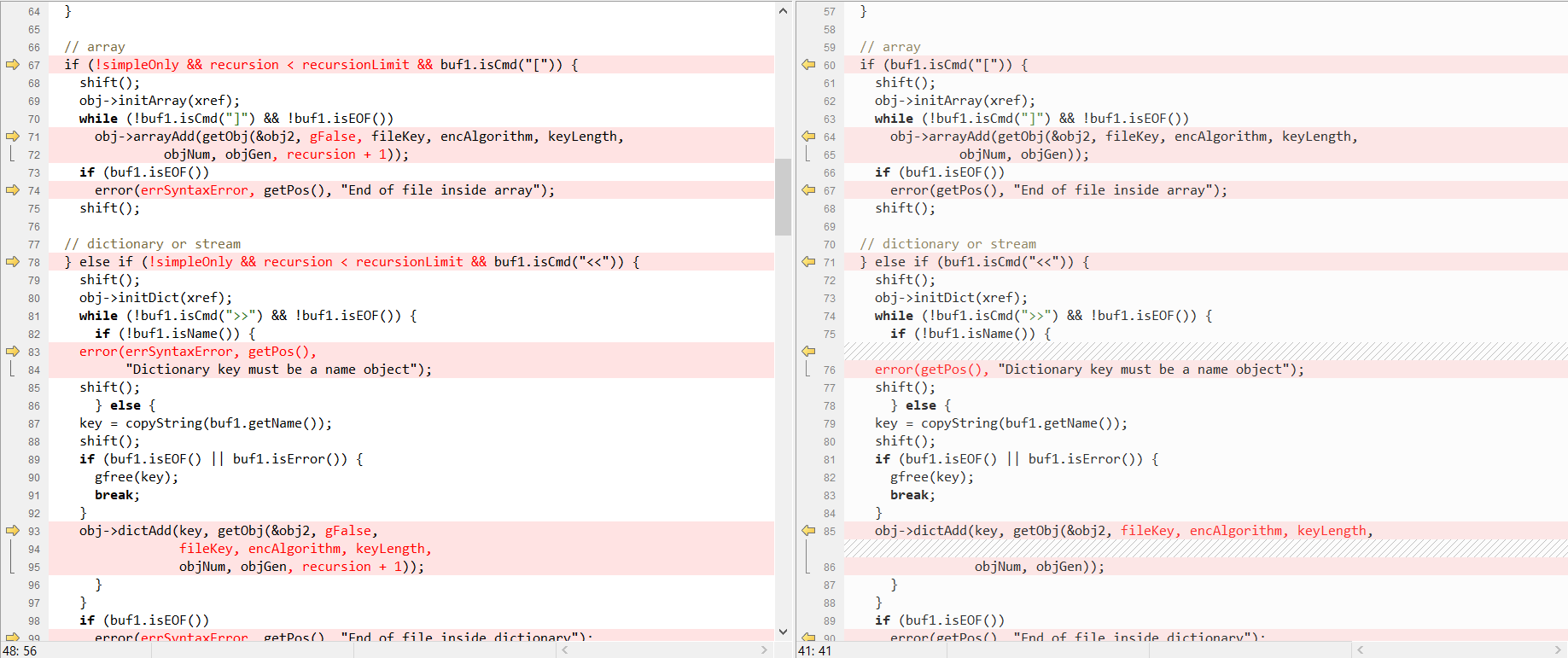
Comparing the vulnerable version with the patched version shows the fix is simply the addition of a recursion depth limit. Across versions, essentially nothing changed except the protection against recursion.
#define recursionLimit 500

Object *Parser::getObj(Object *obj, GBool simpleOnly,
      Guchar *fileKey,
      CryptAlgorithm encAlgorithm, int keyLength,
      int objNum, int objGen, int recursion) {
The added recursion parameter increments on each call and is checked against recursionLimit. Nothing else changed. The entire vulnerability and its fix come down to adding a single depth counter.
Summary
- Coverage-guided fuzzing with AFL can find stack-overflow crashes caused by unbounded recursion in a parser.
- Triage involves identifying the repeating call pattern in the backtrace and tracing the call chain in the source to find the recursion point.
- Dynamic patching through a debugger lets you verify the root cause by redirecting the loop-inducing condition without recompiling.
- The upstream fix was minimal. A single depth-counter parameter prevents the infinite recursion.